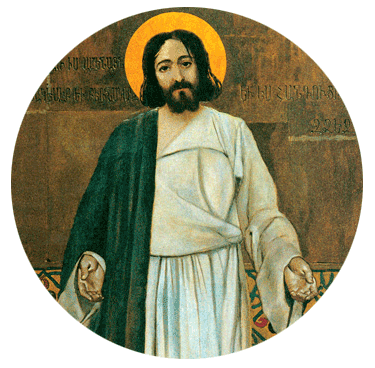
St. James of Nisibis
About This Saint
The Armenian Church commemorates the feast of St. James of Nisibis on the Saturday following the Third Sunday of Advent. A fourth-century bishop, ascetic, and participant in the 1st Ecumenical Council of Nicaea (325 A.D.), St. James was connected to Armenia through his relation to St. Gregory the Illuminator. Revered for his holiness, miracles, and deep faith, he became one of the most beloved saints of the Armenian people. Tradition recounts that an angel presented him with a piece of Noah’s Ark from Mount Ararat. Many Armenian churches bear his name, and his feast remains a cherished celebration during Advent.
This Saint's Life
In Summary
-
St. James of Nisibis was a fourth-century bishop who was considered Assyrian by nationality but was also related to St. Gregory the Illuminator through his mother's side, giving him a special connection to the Armenian Church.
-
During his lifetime, Assyrians and Armenians lived closely together in Mesopotamia, and over time St. James became one of the most beloved saints of the Armenian people, with many Armenian churches dedicated in his honor.
-
He was educated alongside St. Gregory the Illuminator in Caesarea and later became Bishop of Nisibis, participating in the First Ecumenical Council of Nicea (325 A.D.) among the 318 bishops.
-
St. James became renowned for his holiness, ascetic life, and miraculous deeds, earning the title "Skantchelakords" (Wonder-Worker).
-
The most famous story about him tells how he attempted to climb Mount Ararat in search of Noah's Ark. An angel appeared to him and gave him a piece of the Ark, recognizing his faith and devotion.
-
Several important Armenian saints honored St. James through their writings, including St. Gregory of Narek, who composed an oration in his honor, and St. Nerses the Grace-Filled, who wrote the hymn "Haghtogh yev Soorp Hayrabed" ("Victorious and Holy Father").
-
The Feast of St. James of Nisibis is celebrated during the Advent season in December. Tradition holds that the piece of Noah's Ark given to him is preserved at the Mother See of Holy Etchmiadzin, and the feast is especially significant for churches and individuals bearing the name Hagop (James/Jacob).
In Depth
The Feast of St. James of Nisibis is celebrated on the Saturday after 3rd Sunday of Advent.
There are many different traditions concerning the identity of St. James of Nisibis. He is considered an Assyrian by nationality, so one might wonder why he is included in a series of Armenian saints.
St. James was partly Armenian. Although his father was an Assyrian, he was related to St. Gregory the Illuminator on his mother’s side. Moreover, the Assyrians at that time were in close relationship with the Armenians, as were the Parthians. Assyrian Mesopotamia was virtually a part of Greater Armenia, and there were many Armenians and Assyrians living together in that region using the Armenian language.
Eventually, St. James of Nisibis became one of the most popular saints of the Armenian people. Armenians have shown an extraordinary affection and devout fervor towards him.
Many Armenian churches are dedicated in his name.
There are two other apostolic saints with the name James mentioned in the New Testament. One of these, St. James (brother of the evangelist John), is also known as “the Beheaded.” The other St. James is “the Lord’s brother,” the first bishop of Jerusalem, who set the foundation of the apostolic see of the Armenian Patriarchate of Jerusalem.
We do not know the exact dates of the birth and death of St. James of Nisibis. We can only say that he was a man of the fourth century, for he lived and labored around 350 A.D. His life and character have some legendary qualities. He was educated during his childhood with St. Gregory the Illuminator in Caesarea (of Cappadocia), the famous educational center of Asia Minor. Caesarea is adjacent to Armenia and is known as Lesser Armenia (Pokr Hayk).
St. James of Nisibis was consecrated bishop for the See of Nisibis in Mesopotamia by Melidios, Archbishop of Antioch. His consecration took place in Amit (near Tikranagerd), and thenceforth he was known as St. James of Nisibis after the name of his episcopal see. He was one of the 318 participant bishops at the First Ecumenical Council of Nicea (325 A.D.).
He became famous for his virtuous and pious life and asceticism. He won fame and popularity especially for his “wonder-working” power, for which he is sometimes called skantchelakords, which means “wonder-worker.”
The most beautiful story linked with his name is the famous legend that St. James of Nisibis wanted to climb Mt. Ararat in order to find Noah’s Ark. Despite his old age, he set out to climb the huge mountain.
On the way, he stopped to rest and fell asleep. In his sleep, an angel approached him and told him that he was too old and that it would be humanly impossible for him to climb all the way to the top. But to satisfy his ardent desire and deep faith, the angel gave him a piece of Noah’s Ark, saying to him, “Take this and satisfy your desire.”
St. James, being content with this piece of Noah’s Ark, returned home.
Certain writings, doctrinal and moral-ethical in character, are traditionally ascribed to St. James. Also, important works have been written in his honor. For example:
(a) St. Gregory of Narek, the great Armenian mystic of the tenth century, wrote a beautiful oration dedicated to him.
(b) The chant of his feast day, known as “Victorious and Holy Father” (Haghtogh yev Soorp Hayrabed), was written by St. Nerses the Grace-filled, the great poet and theologian of the twelfth century.
The feast day of St. James of Nisibis is commemorated during the Advent season in the middle of December. The Feast of St. James of Nisibis is the name day of those churches that are named after him, as well as for men whose names are Hagop (Jacob or James).
As an additional note, it is worth mentioning that, according to traditional pious belief, this piece of Noah’s Ark is housed at the Holy See of Etchmiadzin.
(From Living the Armenian Church Year, Fr. Tavit Boyajian 2011)