



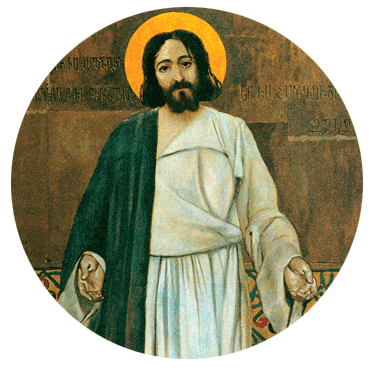
The Armenian Church calendar lists the following saints under the title “Holy Translators”: Sahag the Parthian, Mesrob Mashdots, Yeghishé, Movses the Grammarian, David the Invincible, Gregory of Nareg, and Nersess of Hromgla.
The English word “translator” hardly does justice to the Armenian word tarkmanich. To our ancestors the word tarkmanich had the meaning not only of translator, but also of commentator, narrator, writer, poet, rhetorician, historian, intellectual, and philosopher.
For this reason, the group of saints labeled as Holy Translators includes the familiar names of Sahag and Mesrob, but also the names of a 5th-century historian, a 6th-century grammarian, a 6th-century philosopher, a 10th-century poet, and a 12th-century theologian.
Sts. Sahag and Mesrob are considered major saints of the Armenian Church for of their efforts to spread spiritual and intellectual enlightenment throughout Armenia. Under the inspiration of God and the sponsorship of King Vramshabuh and Catholicos Sahag, Mesrob Mashdots created the Armenian alphabetic script in A.D. 406. His foremost endeavor was to translate the Holy Scriptures into Armenian. For a period of four decades, Sahag and Mesrob established schools, educated the young, and spread the word of God throughout Armenia and its neighboring regions. The literary output of these 5th-century figures is referred to as “the literature of the Golden Age.”
Below are brief sketches describing the five other figures honored in the calendar as Holy Translators.
St. Yeghishé Vartabed:
St. Yeghishé, the historian of the Vartanants War, was the secretary of St. Vartan Mamigonian, chaplain of the Armenian troops, and a former pupil of Sts. Sahag and Mesrob. As a bishop he participated in the Council of Ardashad in A.D. 449, when Armenians openly defied the Persian demand to convert to Zoroastrianism.
After the great rebellion of 451 and the martyrdom of St. Vartan, Yeghishé spent years in seclusion, living a solitary existence on the mountains of southern Armenia. When his fame as a saintly man became known, he moved to the mountains south of Lake Van. He died in the wilderness and was buried there; his grave in the village of Varishad could be seen until the early 19th century.
St. Yeghishé was a prolific author, who spent most of his life in military camps and in the wilderness. Most people know him as the historian of the Vartanants War: a unique piece of Christian historiography, full of philosophical reflections and poetical inspiration. Other writings are attributed to Yeghishé, but only some are considered genuine. These include writings on the Transfiguration, the human soul, and the Old Testament books of Genesis, Joshua, and Judges.
St. Movses Kertogh (the Grammarian):
Very little is known about this saint, but he is mentioned as the teacher of writers who flourished in the 6th century. This leaves no doubt that he actually lived sometime in the first half of that century.
Movses Kertogh was the bishop of Pakrevant: a man well-versed in Greek grammar, rhetoric and philosophy. Modern scholarship attributes to him the translation, from Greek, of the Grammar of Dionysius Thrax: a landmark in the history of Armenian literature.
His works opened the way to new translations and original works in philosophy and theology. Technical words and idioms formulated by Movses remain indispensable today for coining scientific and philosophical terminology in modern Armenian.
Movses is also one of the earliest hymnographers of the Armenian Church. A medieval list names Movses as author of all the hymns of the Theophany (Christmas) cycle, several on the Resurrection (including the Magnificat hymns), and others hymns
St. David the Invincible:
Although tradition states that St. David the Invincible was a pupil of Sts. Sahag and Mesrob, it has now been established that he is a late 6th/7th-century personality. Like Mesrob Mashdots, he came from the district of Daron.
As a young man he went to Alexandria, Egypt, and studied in the renowned Neo-Platonic school there with a philosopher named David. The latter is also known to have been a Christian of Armenian origin. The fact that both teacher and pupil have identical names has created much confusion in historical works, with the result that the works of these two Davids have all been attributed to one person.
The David we venerate as a saint is responsible for the Armenian translations of a number of philosophical works. He was surnamed “the Invincible” because of his invincibility in philosophical dialectic.
David’s translations provided Armenians with a philosophical language they could employ in theological discussions. His Armenian translations of the works of Aristotle—rendered from manuscripts more ancient than those we have today—have been extremely valuable for understanding that great Greek philosopher.
St. Gregory of Nareg:
St. Gregory of Nareg is known for his prayer book, The Book of Lamentations. He was the son of a priest named Khosrov, who after his wife’s death was elevated to the rank of bishop.
As a boy, Gregory was placed in the care of his mother’s uncle, Anania Vartabed, abbot of the Monastery of Nareg south of Lake Van. He was among the first generation of pupils at Nareg (founded in the mid-900s). Gregory became a monk and spent his life in the monastery teaching and writing.
His saintliness was acknowledged during his lifetime. He spent time in seclusion, praying in a cave by the lake, where he received a vision of the Holy Virgin with the baby Christ in her arms. He later wrote about this miraculous experience.
St. Gregory died on October 7, 1003 and was buried in Nareg. The monastery remained a pilgrimage site until 1915; but following the Genocide it was razed to the ground. In 1021 Gregory’s relics were laid near the city of Agn and a monastery was built there. By the 19th century, however, the monastery was in ruins, and after 1915 the site was abandoned entirely.
Besides The Lamentations, St. Gregory wrote a commentary on the Song of Songs and odes dedicated to feast days–some of which are still chanted at the beginning of the Divine Liturgy.
St. Nersess Shnorhali (the Graceful):
St. Nersess Shnorhali was born in the early 12th century, to a family that traced its ancestry from St. Gregory the Illuminator. Various members achieved renown as generals, statesmen, and men of letters in the 11th and 12th centuries.
Orphaned as a boy, Nersess and his older brother Gregory were placed in the care of their great uncle Catholicos Gregory II. While his brother ascended to the patriarchal throne in 1113, Nersess was sent to Garmir Vank near Kesun (a town east of Cilicia). His title shnorhali —“the graceful” or “grace-filled”—is thought to be an honorific bestowed on distinguished alumni of the Garmir Vank.
As a bishop, Nersess became his brother’s chief adviser at the catholicate of Hromgla (an outcrop on the Euphrates, in southern Turkey). His diplomatic missions with Latin and Greek churchmen influenced his outlook, shaping Nersess into a world-renowned ecumenist. When he became catholicos, Nersess’ letters with the Byzantine emperor Manuel Comnenus led to an attempt to unite the Armenian and Greek churches; but the effort failed because of Nersess’ death and the Byzantines’ crushing defeat at the hands of the Seljuks of Rum. Nersess died in 1173 and was buried at Hromgla.
One of the most prolific Armenian writers, St. Nersess Shnorhali is the author of epics, poems, encyclicals, pastoral letters, and theological treatises. He is best known, however, for his prayers, songs, and hymns—which still constitute the bulk of the Armenian Book of Hours and our Hymnal.
— Fr. Krikor Maskoudian, adapted from his book, The Holy Feasts of Saint Gregory the Illuminator: Celebrating the Life & Lineage of Armenia’s Patron Saint (New York: St. Vartan Press, 2003).