



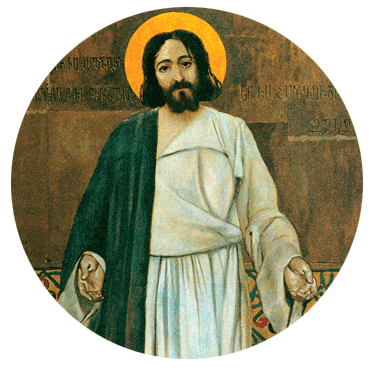
St. George
About This Saint
The Armenian Church celebrates the feast of Saint George on the Saturday before the third Sunday in the Season of the Cross. George is a great saint and martyr of the Christian Church, known in both Eastern and Western churches. Though the West celebrates his feast on April 23rd, the Armenian Church fittingly celebrates his feats in the season of the cross. Refusing to give in to the moral depravity of his time, George sacrificed his very life to uphold truth and goodness. George put into practice Jesus’ words that ‘If anyone would come after me, let him deny himself and take up his cross and follow me.’ Following Jesus, George was executed for his faith, and just as Jesus, the cross he bore has become a means for lifting up all Christians who persevere through sin and suffering with hope and love.
This Saint's Life
In Summary
- Saint George was a brave and faithful man who loved God and his fellow people.
- He stood against Emperor Diocletian’s edict to worship idols and spoke out against the injustice.
- Despite threats & torture, St. George remained steadfast in his faith & performed miracles.
- He was beheaded for his beliefs, but his body was buried in Lydda, and a grand church was built in his name.
- Lessons learned from Saint George’s story include being brave, standing up for what is right, trusting in the Lord, helping others, respecting others’ beliefs, and being understanding and compassionate.
- A later Western legend tells of St. George facing up to a dragon that terrorized a village. Refusing to flee, he fought the dragon, discovered a vulnerable spot beneath its arm, and killed it, bringing peace to the villagers. The event is celebrated annually on Saint George’s Day, particularly in England, where he is the patron saint.
In Depth
St. George the Great-martyr, was raised a Christian. His father was martyred for the faith. After his father's death, his mother took him to Palestine, where she had farmland. At a young age, he served in the Roman army under Emperor Diocletian and was commended many times for his service to the Empire. From the rule of the Emperor Decian until 284 A.D., when Diocletian became emperor, the Church went through a period of peace and prosperity. Christians obtained important positions in the government during that time; many built churches and schools and organized the authoritative structure of the Church. Diocletian gave many of his loyal officers political positions so that he could have the military strength of his Empire on his side. After Diocletian had suppressed the barbarian tribes which were attacking the Empire and after he had secured its borders, he began to concentrate on the Empire's internal affairs. Diocletian believed that a state religion could keep the empire united. Since paganism was the state religion, Diocletian focused his efforts toward the suppression of Christianity.
During the year 303 A.D., Diocletian summoned his aides to meet in Caesarea, a city of the Eastern Roman Empire. He held three general meetings with his aides, instructing them to persecute the Christians. St. George, since he had shown his excellence while serving in the army, was among these aides. Diocletian asked them to pledge their allegiance to this cause by making pagan sacrifices as proof of their loyalty. All the aides pledged their loyalty except St. George. He stood in front of Diocletian and admitted his belief in Christianity, telling the monarch of the Christian teachings and the Godliness of the crucified Nazarene. The emperor ordered this Christian to be taken to prison and that a boulder be placed on his chest as a form of torture. The next morning Diocletian ordered that the prisoner be brought before him for questioning. George stood steadfast and told Diocletain of his belief in the riches of the Kingdom of Heaven. The emperor then summoned the executioners to take the saint and have him bound to the rim of a wheelset with sharp spikes. Diocletian admired the courage of the saint and asked him to sacrifice to the gods to save himself. He refused Diocletian's request and welcomed the chance to martyr for Christ, as his father had done. After praying to God, he heard a voice from heaven say, "Do not fear, George, I am with you." With the help of Christ, the spiked wheel had no effect on St. George. When the saint appeared before Diocletian not only was he unharmed, but an angelic aura had settled about him. Suddenly, two officers of the Roman army, Anatolios, and Protoeon appeared before Diocletian with two thousand soldiers. They admitted their belief in Christ and Diocletian had them all executed.
A later Western legend tells of St. Geroge facing up to a dragon that terrorized a village. The evil being demanded daily sacrifices of livestock and eventually humans when supplies ran out. One day, the king’s daughter was chosen as the next victim. Saint George, a Christian soldier, encountered her on the way to the dragon’s lair. Refusing to flee, he fought the dragon, discovered a vulnerable spot beneath its arm, and killed it, rescuing the princess and bringing peace to the villagers. The event is celebrated annually on Saint George’s Day, particularly in England, where he is the patron saint.